2nd Try for the Performance Verification


After failing my Performance Verification (PV) in Auburn, Indiana back in April, I had to wait almost six months for the NCRS Texas Regional Meet and a second chance at the PV. For six months, every time I stepped into the garage, I would see the silver Corvette sitting there and remember the sting of failure in Auburn. Every time my thoughts cleared for even a moment, the nagging anxiety of what lay ahead would jump back into focus:
You've still got that PV coming up.

It was my first thought waking up in the morning and the last thought when I fell asleep at night. Nerve wracking to say the least.
Time plodded on. Finally, the first week of October, three weeks before the Texas Regional, my mechanic, Dan Martin, called and said he was ready for me to bring the car to his workshop for some final tweaks. We installed the missing radio bezel controlling the treble/bass. Then Dan Martin took the right wiper arm off the car and took it to a jeweler for the silver solder that had to be used to solder the washer tube back onto the wiper arm. The silver solder didn't seem to be holding well enough, so he eventually had the jeweler use gold solder. Sometimes it's the little things that get expensive.

The last checklist item on the PV is the vacuum pressure hold test. With the car running, you raise the headlights with the override switch. Then you shut off the car. After a minimum of one minute, you push in the override switch. If the vacuum system isn't leaking and is holding residual pressure, the headlights should go back down. If they don't, that indicates there is a leak somewhere in the vacuum system and you fail the test--and the PV.
We were still using most of the original rubber vacuum hoses on the car. We rebuilt the vacuum canisters, pumps, and switches, and Dan had even gone over the entire system with a stethoscope listening for leaks. After replacing a couple of the hoses, we were able to get the system to hold pressure for a minimum of one minute before the first PV try. However, for the last several months the wiper door had been opening and closing when the car was started, indicating a faulty vacuum relay, and the car stopped holding pressure after engine shut off.
We had the faulty relay rebuilt and replaced the wiper door override switch, which solved the leak problem. We were back to holding pressure for as long as 1 minute 45 seconds.
Finally, the day arrived to load up the Corvette and head to Frisco, Texas. I detailed the car inside and out, and my wife guided me as I loaded the car into the trailer.

My wife Staci was unable to attend this Meet due to another engagement, so I was on my own for the drive to Frisco. I followed my mechanic towing his trailer, taking another car up for Top Flight judging.
We learned our lesson from the first attempt and went a full day early so we would have time if anything needed to be addressed. We found the trailer parking area, dropped off the trailer, and checked in at the hotel. Everything seemed in order, and I felt ready. Even so, I hardly slept a wink that night.
The next day, October 20th, dawned cool and clear. I got to the trailer about 8 AM and we rolled the car out to await the judge. Other corvettes in the trailer lot started getting their operations checks, but my PV wasn't scheduled until noon. The next four hours seemed to take forever.


The judge was Chuck Berge, the NCRS National Team Leader for C3 corvettes. He was the same judge who gave me the PV on my first try in Auburn, Indiana. I was hoping he would remember the car and cut me some slack. Part of me hoped he might just check the two items I had failed and pass me! But nope! When Chuck showed up on time at noon, we did the whole thing again. Just like back in Auburn.
Cold start. Check.
1500 rpm fast idle. Check.
Lights, Air Conditioning system, doors, windows, mirror, radio, storage compartments, turn signals, fiber optic indicators, everything. Check.
Windshield wipers and washers. Check.
Headlight washers. Uh oh. When I turned on the washers, fluid was not squirting on the right headlight. Chuck came around to the driver's door. I got out and went to the front of the car while Chuck pushed the washer button again. Suddenly, it started squirting. "Chuck, get up here! It's working!" Whew. Got the gremlin out of our system.
Finally, it was time for the 10-mile drive.
At some point during the driving test, I must accelerate up to within 90% of the redline rpm on the tachometer. That's about 5040 rpm. At some point after the first PV drive back in April, a slightly loose alternator belt shredded, Dan surmises it happened during the acceleration to redline part of the test. For this second try, we made sure to have a new, tight belt on the alternator. I drove Chuck on the 10-mile course, and we ended up at the entrance to the Convention Center, where the cars would be parked for the remainder of the weekend. The drive seemed to go smoothly to me, and Chuck jumped out when we entered the Convention Hall. I paused for a picture in the car, and then followed the guidance to my parking spot.
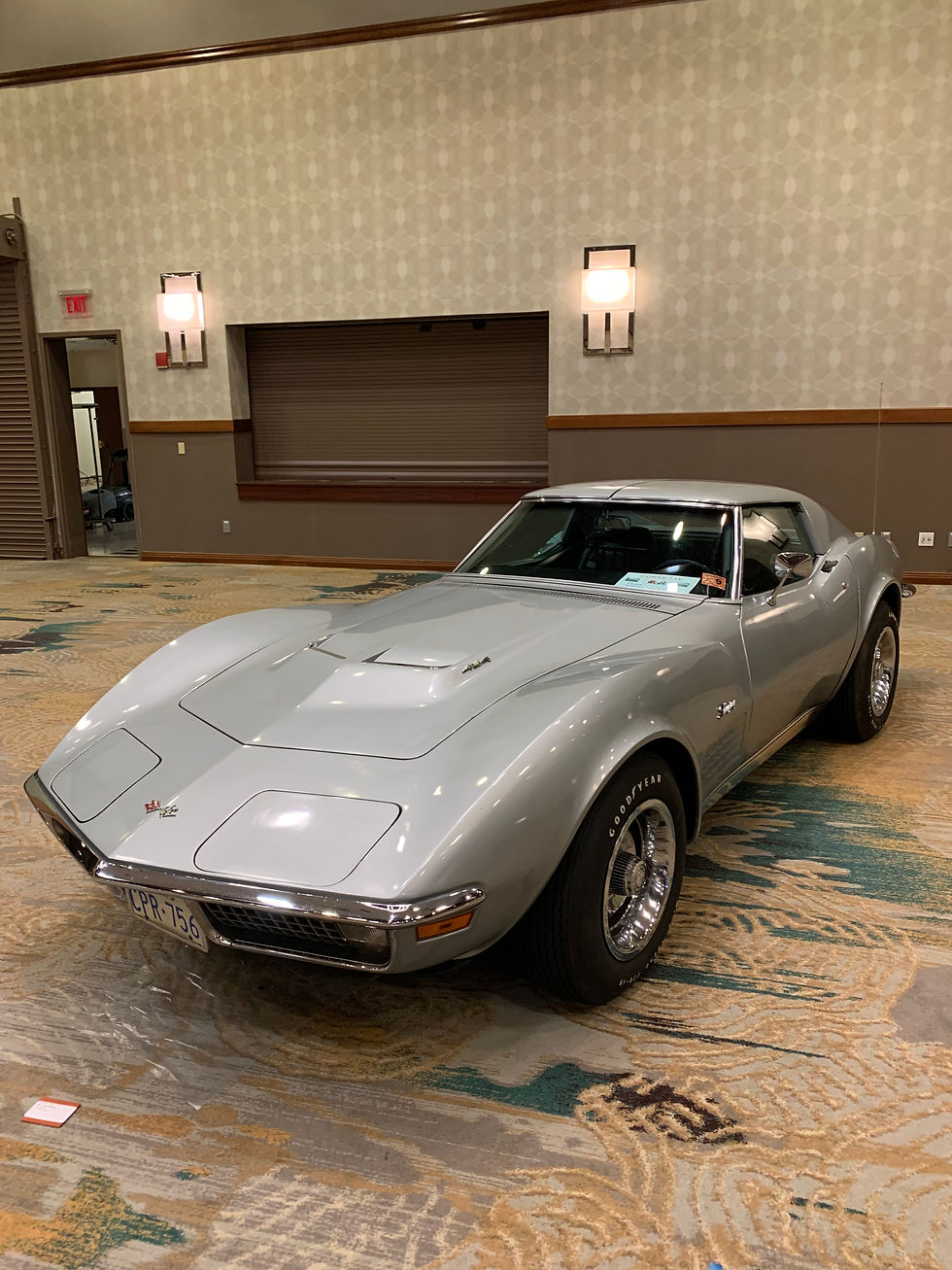
I nervously waited for Chuck to return.

Finally, Chuck came back over to the car. He was wearing a big grin and he stuck out his hand.
"Congratulations, Kenneth. You passed."

I couldn't believe it. I almost started to cry.
I PASSED!
About that time, my phone rang. It was my mechanic, Dan Martin. He had expected me to return to the trailer lot after the drive. A lot of time had passed, and I hadn't returned. He was worried. I quickly reassured him with the great news that we had passed the PV.
I called my wife to share the good news and teared up again from the flood of emotions. Such a great weight had been lifted from my shoulders.
I basked in the joy of success for the remainder of the weekend. It was another great NCRS Meet, and lots of folks congratulated me on the great accomplishment.

Saturday night was the awards banquet, where the NCRS National Judging Chairman, Dave Brigham, gave me my ribbon. There were over 40 Corvettes being judged for Top Flight, and seven Performance Verifications. Out of the seven PV's, five passed. That's much better than the average pass rate. I'm told as much as 75% fail their first PV.

I grabbed a picture with my mechanic and good friend, Dan Martin. His experience and mechanical expertise were what got me to the finish line. I simply could not have done it without him. He's a proud papa when one of "his" cars passes judging. Just to give you an example of his skill, the car he trailered up for this meet was a 1967 Coupe. He estimated it would lose 189 points in judging and earn a 95.6% score. The actual final tally for that car? 191 points deducted, and a 95.7% score. I'm beyond happy that I had Dan Martin to restore my car, one of his last restorations before retiring from full time Corvette work.

Even today, a week later, I still grin when I look at the ribbon, knowing what a prestigious honor it is, given the difficulty of restoring a 52-year-old car to the point where 100% of it works the way it did when it rolled out of the Saint Louis Corvette plant on July 14, 1970.

So, what's next?
In July 2023, I'm taking the car to French Lick, Indiana for the NCRS National Meet. I'll enter the car for National Top Flight judging. If I score another 97% or better, and I should, having already been scored at 97.5% by most of the National Juges at the Regional meet back in 2021, I'll reach the end of the journey with a Duntov award.

From the NCRS website:
NCRS DUNTOV Mark of Excellence Award®
This award was created by the National Corvette Restorers Society in 1985, in honor of Mr. Zora Arkus-Duntov, long-time Chief Engineer for the Chevrolet Corvette, who retired from General Motors in 1975. The Duntov Award recognizes individuals for the restoration and preservation of 1953 -1974 Corvettes. To achieve this coveted award, an owner must attain a judging score of at least 97% out of 100 % based on an original "as manufactured" standard at a National or Regional NCRS event; as well as present the car for a rigorous performance test of all vehicle mechanical components and functions, all of which must operate as those of a new car, without a single failure. Finally, the car must again score at least 97%, at a National NCRS Convention, to receive the Duntov Award. The process of achieving the Duntov Award requires attendance at a minimum of three events and must be completed within a three-year period. Only 1,137 Corvettes have achieved the NCRS Duntov Mark of Excellence Award.
That's the goal, and we're almost there.
Stay tuned!


Comments